Platform · 06 Improve

Make every resolved case count beyond the case.

Find the rule creating noise. See where reviews get stuck. Use outcomes to improve the data, controls and customer-model learning behind the next decision—not simply to close the current case.

  • Action policies you configure
  • Review with reasoned overrides
  • Outcomes feed deliberate improvement

Reporting & improvement

Find the rule making noise. See the work behind the number.

A lower review rate is not automatically better protection. Risk leaders need to see which rules create work, what investigators find and where genuine customers encounter friction.

The Command Center separates overview, investigation and rule analytics. A live event stream and decision mix give immediate context; rule and case outcomes help explain what the operation is doing.

SENTR Product viewDemo data
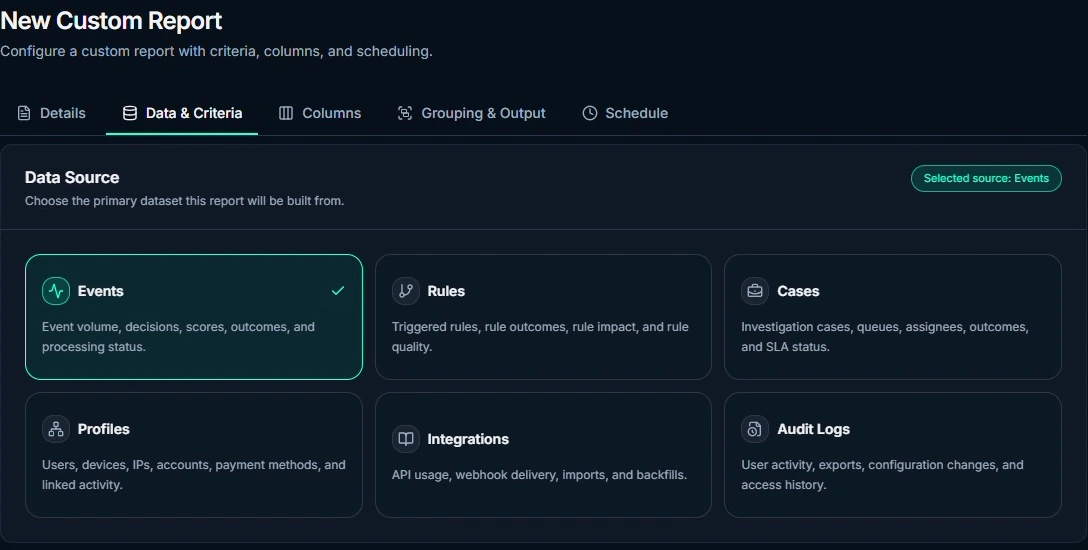
SENTR custom report builder with Events, Rules, Cases, Profiles, Integrations and Audit Logs as data sources, plus criteria, columns, grouping, output and schedule tabs. Enlarge view
Build the report around the question

SENTR.Citadel’s custom report builder: choose a data source, then shape criteria, columns, grouping and schedule.

Start with the operational question—not the spreadsheet export you happen to have.

Build the report around the question

SENTR.Citadel’s custom report builder: choose a data source, then shape criteria, columns, grouping and schedule. Product demonstration · synthetic data.

Go deeper: Reporting & improvement
Inspect rule quality
Review trigger trends, decision impact, utilisation, backtest results and noisy rules—controls generating review work without confirmed findings. Use that evidence to choose what to test next.
Start with 30+ standard reports
Explore confirmed fraud, false positives, manual versus automatic decisions, rule performance, score distributions, case outcomes, case aging, queue workload and risky profiles. Export CSV, XLSX or PDF.
Build the question your team needs answered
SENTR.Citadel custom reports use events, rules, cases, profiles, integrations and audit logs. Choose criteria, columns, grouping and output; run now or schedule. Generated output history keeps past reports accessible.

Connect operational effort to confirmed outcomes. Fraud-loss and false-positive conclusions still need reliable labels, a defined population and enough time for outcomes to mature.
Three ways to close the loop.

Start with reports and case outcomes. Then improve the part of the system the evidence points to—not automatically the model.

  1. Is the context wrong or missing?

    Repair the inputs.

    Inspect missing history, inconsistent identifiers or an incorrect field mapping before making a rule less sensitive. A returning customer should not look new because their past never arrived.

    Validate the corrected context against relevant events.

    Return to Ingest →
  2. Is a control creating the wrong work?

    Change the control. Check the effect.

    Use reports and case evidence to choose a rule, list, scoring profile or policy adjustment. For a rule change, use the relevant tests, backtesting or Monitor before publishing. Keep an accountable owner.

    Observe outcomes after the change—not just the drop in alerts.

    Return to the control workbench →
  3. What can the customer model learn?

    Feed learning with evidence.

    Validated outcomes and corroborating signals inform the customer-model feedback process. Training is scheduled and depends on sufficient suitable data; an override is not blindly accepted as ground truth.

    Keep model findings and later case outcomes distinguishable.

    Inspect customer-specific learning →

These are operating paths, not promises of automatic optimisation. AI rule-building assistance is available alongside the operator’s control workbench. A closed case does not instantly retrain a model or guarantee an improvement.

What good operations feel like

Low-ambiguity events should not consume senior analysts. High-ambiguity money movement should not disappear into an unexplained auto-block. The split has to be visible in policy—and ownership depth has to match the team (SENTR.Citadel vs SENTR.Tower).

Autonomous analyst agents and automated dispute settlement are not part of this workflow. Timing for adjacent product work is on product status.

Illustrative mechanism
A blocked-event count is not the verdict.Illustrative reporting windows show changing activity alongside approve, review and block categories. The bars are synthetic and do not represent customer performance. Compare the decision mix with validated outcomes, rule noise and review workload before changing a control; fewer reviews alone do not prove better prevention.DECISION MIXAPPROVEREVIEWBLOCK
A blocked-event count is not the verdict.
Read the diagram

Illustrative reporting windows show changing activity alongside approve, review and block categories. The bars are synthetic and do not represent customer performance. Compare the decision mix with validated outcomes, rule noise and review workload before changing a control; fewer reviews alone do not prove better prevention.

A blocked-event count is not the verdict.

Illustrative mechanism. On smaller screens, scroll across the diagram to inspect the labels.

A blocked-event count is not the verdict.Illustrative reporting windows show changing activity alongside approve, review and block categories. The bars are synthetic and do not represent customer performance. Compare the decision mix with validated outcomes, rule noise and review workload before changing a control; fewer reviews alone do not prove better prevention.DECISION MIXAPPROVEREVIEWBLOCK

Illustrative reporting windows show changing activity alongside approve, review and block categories. The bars are synthetic and do not represent customer performance. Compare the decision mix with validated outcomes, rule noise and review workload before changing a control; fewer reviews alone do not prove better prevention.

Let policy move work. Keep people accountable.

01 Decision policy Approve · review · block 02 Action policy Case · notify · webhook 03 Human judgement Investigate and explain 04 Validated outcomes Check the evidence 05 Improve deliberately Model learning + controls AUTOMATION WITH A HUMAN DECISION RECORD. 01 Decision policy Approve · review · block 02 Action policy Case · notify · webhook 03 Human judgement Investigate and explain 04 Validated outcomes Check the evidence 05 Improve deliberately Model learning + controls FEEDBACK IS EVIDENCE, NOT AN INSTANT UPDATE.
Decision policy determines the result; action policy routes the work. Reviewers investigate and record outcomes. Validated outcomes inform customer-model learning and governed control changes, not immediate blind retraining.
Who owns each part of the workflow?

Policy · humans · ownership model

  • Action policy Decision policy sets review/block cutoffs. Action policy triggers downstream cases, notifications or webhooks; your integrated system enforces the returned decision.
  • Human reviewer Investigates uncertain cases with context, records an outcome and explains any override of the system decision.
  • SENTR.Citadel operators Full depth: rules, policies, queues, lists, feedback and reporting on the shared foundation.
  • SENTR.Tower owners Guided presets and a simpler review workflow, with the same underlying engine and decision visibility.

Two events. Two appropriate responses.

Illustrative workflow

Login clears. Payout opens a case.

Login events under a lenient profile auto-allow when contribution stays below threshold. Payout events with beneficiary reuse open a case and notify via webhook.

  1. Login (lenient)
  2. Auto-allow
  3. Payout + reuse
  4. Case + webhook
Response
Reviewer blocks with reason; outcome tags a list update for the fraud owner
Evidence
Dispute packages stay in the process you already run — SENTR does not auto-file them

Volume is handled where policy is clear. Humans stay on material money movement.

Review context itself lives in Investigations. Decision composition lives in Decisions & rules.

Keep the work connected

The next improvement starts with the evidence.

What comes in
Operational reports, case outcomes and the quality of the underlying data.
What moves forward
A reasoned next change—to inputs, controls or eligible model training.

Close the loop where the evidence points: repair inputs, test detection or adjust policy.

Return to Ingest

Revisit detectionAdjust the relevant control

Both operating models retain standard visibility. SENTR.Citadel adds custom reporting and direct tuning; SENTR.Tower keeps configuration guided.

Compare the exact controls ↗

Let policy handle the routine. Give people the context.

Choose guided presets or direct workflow control. We can help map the right setup to your review process.

Your privacy choices

Choose how you use SENTR. Your enquiry, chat and booking do not depend on accepting analytics.

Essential functionality Always active

Delivers and secures the site, remembers this choice and supports the chat or booking you request.

Measures page visits, feature use and enquiry journeys, including recognised campaign sources. Uses analytics cookies. Form answers and chat messages are not sent to Google Analytics.

Advertising trackers are disabled. The same choices apply to UK and EU visitors.

We remember this choice on this browser for up to six months. Changing an active analytics choice reloads the page to stop tracking scripts. Save any unfinished enquiry first.

Website data information