Deterministic contribution
Which rules, lists and score components fired—stored with the decision so operators can reproduce what happened.
Capability · Explain
Read an AI explanation of the relevant findings, then inspect the rules, signals and score contributions behind it. SENTR connects that evidence to the case and any human override—so analysts, risk leaders and reviewers can work from the same facts.
Scattered logs force analysts to reconstruct why a payment was blocked three systems later. Governance and commercial stakeholders need attribution that travels with the decision—and a clear line between what the system computed and what a human changed.
A sample payment event has score 72 and a review response under auth.default. Selected contributions are device velocity +18, first-seen IP +12 and payment-method reuse +8. They show part of the attribution, not a sum to 72. Recorded findings are the evidence; an AI explanation makes them readable.
See what the system calculated, how AI explained it and what a person changed.
What explanation does — and does not — do
Which rules, lists and score components fired—stored with the decision so operators can reproduce what happened.
Natural-language explanations render relevant rule and anomaly findings. Every event retains attribution; quiet events need not generate a prose narrative. The language model explains, never decides.
A written override reason records what changed, who changed it and when—alongside the original system decision.
A withdrawal is blocked on rule contribution plus policy threshold. The on-call reviewer overrides to allow after confirming a known travel pattern, with a written reason.
Nobody has to invent the story after the fact—the decision already carries both machine and human authorship.
Explainability and audit exports help your team inspect and document decisions. They support your assessment; they do not automatically establish regulatory compliance for your deployment.
Machine learning & AI
Authored rules cover patterns your team knows to look for. Unusual behaviour can still deserve attention when no existing rule describes it.
SENTR’s customer-specific anomaly model learns normal activity from clean signals, independently of authored rule outputs. It returns a separate risk score and contributing signals. Training runs overnight once sufficient suitable data is available; evaluation and training are different processes.
 Enlarge view
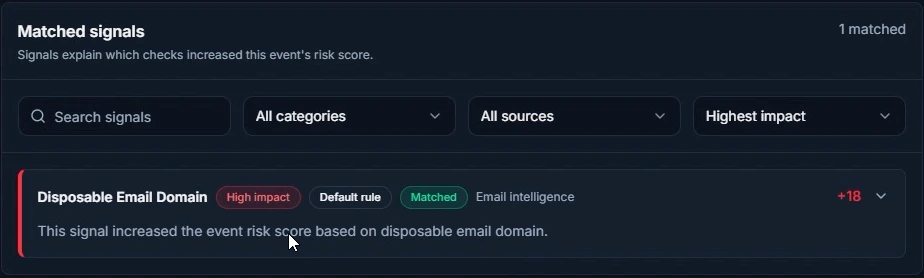
 The matched rule, its impact and the recorded reason—together on the event.
The explanation has something concrete behind it: the matched check and its contribution.
Give analysts readable reasons without hiding the evidence behind them. AI scoring, the AI rule builder, the ML pipeline and automatic feature engineering extend this foundation. Agree their configuration and access for your deployment.
Explore the evidence trail, then show us a decision your team needs to explain more clearly.