Risk appetite
Three different controls. Three different questions.
Making every rule stricter is not the same as changing when you block. A trusted identifier should not automatically excuse every future action either.
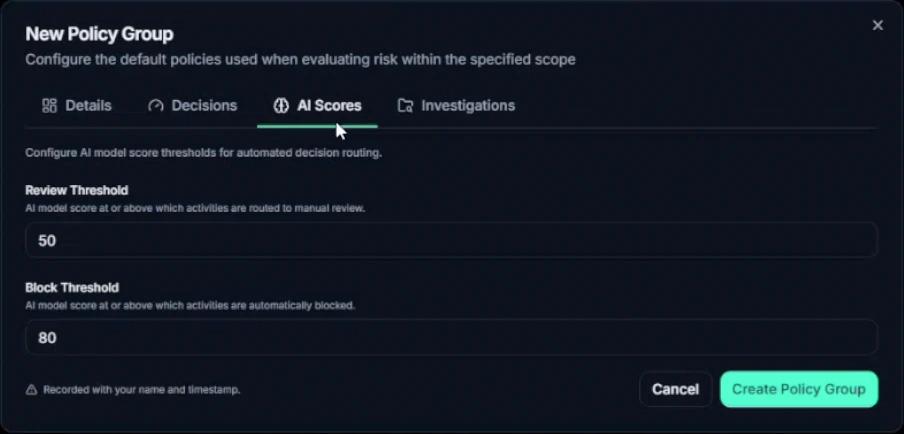
SENTR separates rule sensitivity, decision thresholds and list influence. That gives your operator a more precise way to adapt policy to the event, market and fraud problem.
Go deeper: Risk appetite
- Scoring profiles: what matches?
- Adjust numeric thresholds inside rules for an event type—for example, the domain-age threshold in a registration rule. Binary conditions have no numeric threshold to shift.
- Decision policies: when do we act?
- Set review and block cutoffs, with rule scores and model scores on separate axes. A login and a withdrawal do not need the same appetite. Action policies separately define cases, notifications and webhooks.
- Scoped lists: how much should this matter?
- Set the influence score for an attribute or entity match. Add entries from profiles or in bulk, export them, and disable lists without deleting them. Keep a known customer from becoming a blanket exemption for a suspicious new session.
Change the control that is causing the problem—not the risk appetite of the whole business.