Ingestion
File · REST · CSV · webhook · DB · stream
Choose the ingestion path that fits your existing systems.
Platform · 01 Ingest
Connect product activity, payment events, provider outputs and historical context through supported APIs, webhooks, files, databases or streams. Map the fields once, then use that context across detection, decisions and investigation.
Data engine
A returning customer can look new when the history lives elsewhere. That missing context creates work for analysts and weakens the rules that depend on prior activity.
Bring events through REST APIs, webhooks, files, databases or streams. Map your field names onto SENTR’s model and keep stable identifiers connected across users, devices, sessions, IPs and payment methods.
 Enlarge view
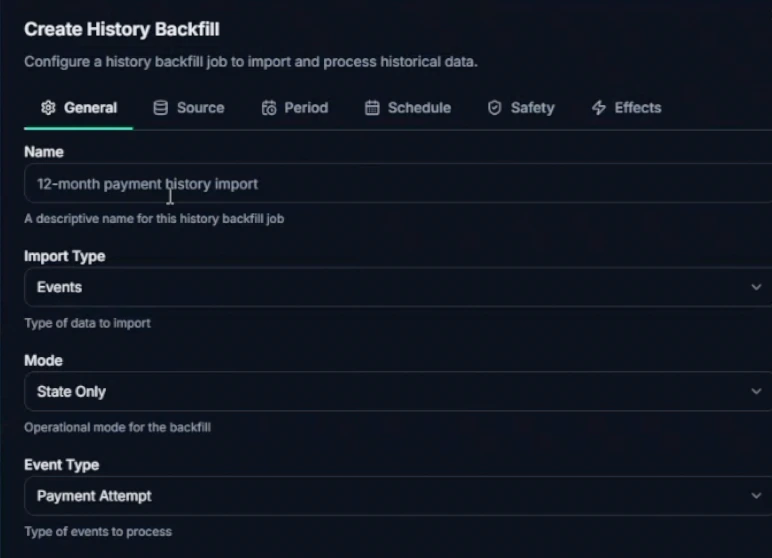
 History-backfill setup. Scope the activity and processing mode before starting the import.
Historical activity gives first-seen, reuse and velocity checks the context they need.
Keep the systems and naming conventions you already use. Give the fraud operation the history it needs to interpret the next event.
Waiting for a vendor’s native connector means waiting on their roadmap. Rebuilding your entire event bus for a new fraud tool means engineering owns a second platform. Either way, analysts keep joining identifiers in spreadsheets because nothing lined up at ingest.
Send the events you already produce, map the relevant fields and backfill available history. Scoped credentials, webhooks and delivery logs give engineering the tools to validate the feed. Automated provider-specific mapping remains in development.
Source fields pass through an agreed mapping into account, device and IP context. Stable identifiers connect later events to the right history. This illustrates the mapping mechanism, not automatic provider mapping or a required event schema.
Integration contract
Ingestion
File · REST · CSV · webhook · DB · stream
Choose the ingestion path that fits your existing systems.
Entities
Users · devices · sessions · IPs · payment methods
Consistent identifiers connect event history to entity profiles and investigations.
Web signals
JavaScript SDK
Device and web signals are available. Full SENTR 360 journey reconstruction is available with the JavaScript SDK. Mobile SDK timing is on product status.
Operability
Keys · signing · delivery logs
Scoped keys, signed webhooks and delivery logs help engineering test and troubleshoot the integration.
Illustrative workflow
A payments team maps payment and payout events plus merchant identifiers into SENTR. Shadow Mode runs on that feed while production still decides in the incumbent stack.
Engineering effort compounds. Cutover stays optional until the evidence is good enough.
Once events are mapped, operators compose appetite in Decisions & rules. When you are ready to compare read-only, see how Shadow Mode works →
Device context helps connect accounts and sessions. It only works when those signals are actually collected and supplied.
Collect a persistent device fingerprint and interaction signals, including clicks, time per step, tab changes and connection loss. Browser automation and developer-tools signals provide additional context—not automatic proof of fraud.
Without the SDK, supply your own consistent device fingerprint and the session signals you possess. Backend payment data alone cannot reconstruct the browser journey.
Full customer-journey reconstruction is available with the JavaScript SDK. It extends the recorded risk-evaluation path with connected journey context. Native mobile SDKs and session replay remain roadmap.
Keep the work connected
With the context connected, inspect how SENTR finds the risk.
Continue to DetectSENTR.Tower starts with a guided integration. SENTR.Citadel supports deeper configuration. Neither can infer data your systems never supply.
Compare the exact controls ↗Before you decide
No. SENTR can evaluate mapped events alongside payment providers and internal systems. It is an independent decision and operations layer, not a payment processor. You need a supported data path and explicit response handling; named-provider integrations are not assumed to be prebuilt connectors.
See the integration model →Agree the event type, required fields, stable identifiers, available history and the action your system should take on the response. Ingesting a payload alone does not guarantee useful connected context or a safe production integration. History backfill helps establish the state needed for reuse and velocity checks.
Work through a schema →Work through your sources, identifiers, history and decision response with us. Request API documentation during a technical review.