Capability · Detect, investigate and improve
Work the fraud problem before it becomes a chargeback.
SENTR helps your team identify suspicious payment activity, investigate connected cases and improve the controls behind the next decision. Keep the evidence for your dispute process—without confusing fraud prevention with automated dispute filing.
A chargeback is an outcome. Start with the events.
Repeated payment attempts, changed account details or a reused instrument can matter before the payment completes. SENTR connects the mapped signals, rules and history so the configured policy can respond with a decision your team can inspect.
Not every chargeback is fraud, and not every fraud loss becomes a chargeback. Assess payment losses, legitimate-customer friction and review effort separately. No website estimate proves a reduction in your operation.
Read the diagram
A synthetic payment event connects account, available device and IP context. Carry the relevant history into the decision rather than treating a successful checkout as approval for later changes. Device context must come from the relevant actor; an operator-entered MOTO payment does not establish the cardholder’s device.
Prevention, evidence and improvement belong together.
Payment-fraud and chargeback-prevention workflow
- Before the payment Bring account, device and previous activity into the payment decision rather than scoring the amount alone.
- At the decision Combine scoped rules, AI/model signals and policy. Inspect what contributed before adjusting a noisy or insufficient control.
- When a case needs review Connect events and evidence, record the investigation and retain the reason for a human override.
- When outcomes arrive Link confirmed outcomes into reporting and validated improvement. Keep fraud findings, chargeback outcomes and modelled savings distinct.
Keep the reason—not just the final status.
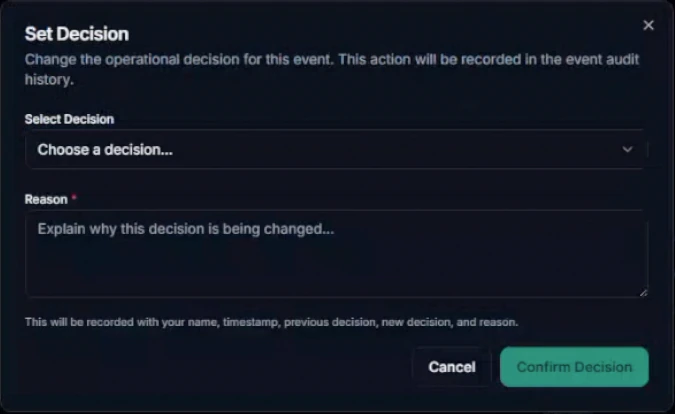
When a reviewer changes a decision, the written reason and attribution remain in the record. Casework and exports support the dispute process your team already owns.
 Enlarge view
 A human decision change requires a reason. The dialog identifies what will be recorded in the event history.
Keep system findings and human judgement distinguishable.
Test the value without assuming the answer.
A qualified Shadow Mode evaluation runs read-only beside your current controls. Agree a baseline and review differences, including genuine customers who would be affected. Longer-lag fraud and chargeback outcomes may need follow-up beyond the evaluation window.
Build an illustrative payment-value estimate → · Evaluate false-positive friction too →
Before you decide
The questions worth asking.
Does SENTR automatically file or settle chargeback disputes?
No. Current casework, decision records and report exports can support the dispute process your team already runs. Automated dispute filing, representment and financial settlement are not current product capabilities.
See product availability →Can a 50-day evaluation prove the final chargeback reduction?
Not necessarily. Shadow Mode compares agreed events and decisions, but some fraud and dispute outcomes take longer to mature. Separate observed findings, reviewed labels and modelled financial effects; agree a longer follow-up window where needed.
Inspect the proof boundary →Bring the losses—and the customers—you want to protect.
We will work through event coverage, review ownership and the evidence needed to evaluate the opportunity. Production enforcement is a separate decision.