Capability · Detect and investigate

The account looks familiar. The behaviour does not.

Catch the context behind account takeover and multi-account abuse. SENTR connects registration, login, device and payment activity so your team can investigate the pattern—not just react to the next suspicious payment.

A login is one moment in a longer story.

A returning account appears on an unfamiliar device, changes a sensitive profile field and requests a payout. Any one event may look ordinary. Together, they give your reviewer a better question to investigate.

SENTR evaluates the events and context you map: account history, device and interaction signals, reused identifiers and rule contributions. The JavaScript SDK supplies web signals; API-only business events do not automatically contain browser telemetry.

Inspect device and event integration →

Illustrative mechanism
A familiar account can have an unfamiliar session.An account and session connect to a new device and first-seen IP. Inspect that change alongside authentication history and the next withdrawal or transfer. Neither a new device nor a new IP proves takeover; event-specific controls and investigation determine the response.SESSION RISKACCOUNTacc_19c2SESSIONses_04e9IPNEW DEVICE · FIRST-SEEN IPauthentication.attempt
A familiar account can have an unfamiliar session.
Read the diagram

An account and session connect to a new device and first-seen IP. Inspect that change alongside authentication history and the next withdrawal or transfer. Neither a new device nor a new IP proves takeover; event-specific controls and investigation determine the response.

A familiar account can have an unfamiliar session.

Illustrative mechanism. On smaller screens, scroll across the diagram to inspect the labels.

A familiar account can have an unfamiliar session.An account and session connect to a new device and first-seen IP. Inspect that change alongside authentication history and the next withdrawal or transfer. Neither a new device nor a new IP proves takeover; event-specific controls and investigation determine the response.SESSION RISKACCOUNTacc_19c2SESSIONses_04e9IPNEW DEVICE · FIRST-SEEN IPauthentication.attempt

An account and session connect to a new device and first-seen IP. Inspect that change alongside authentication history and the next withdrawal or transfer. Neither a new device nor a new IP proves takeover; event-specific controls and investigation determine the response.

Connect the account. Keep the judgement.

Account-abuse decision workflow

  1. Registration & login Map account creation, login, device and interaction context. Look for activity that does not fit the account’s history.
  2. Linked activity Follow reused devices, payment methods and other mapped identifiers across events. A relationship is an investigation lead, not proof of abuse.
  3. Configured response Use event-scoped rules, scoring and decision policies to approve, review or block. Your integrated system enforces the response.
  4. Investigation & feedback Inspect the explanation, work the linked case and record a reasoned outcome. Validate feedback before using it to improve controls.

Open the relationship behind the alert.

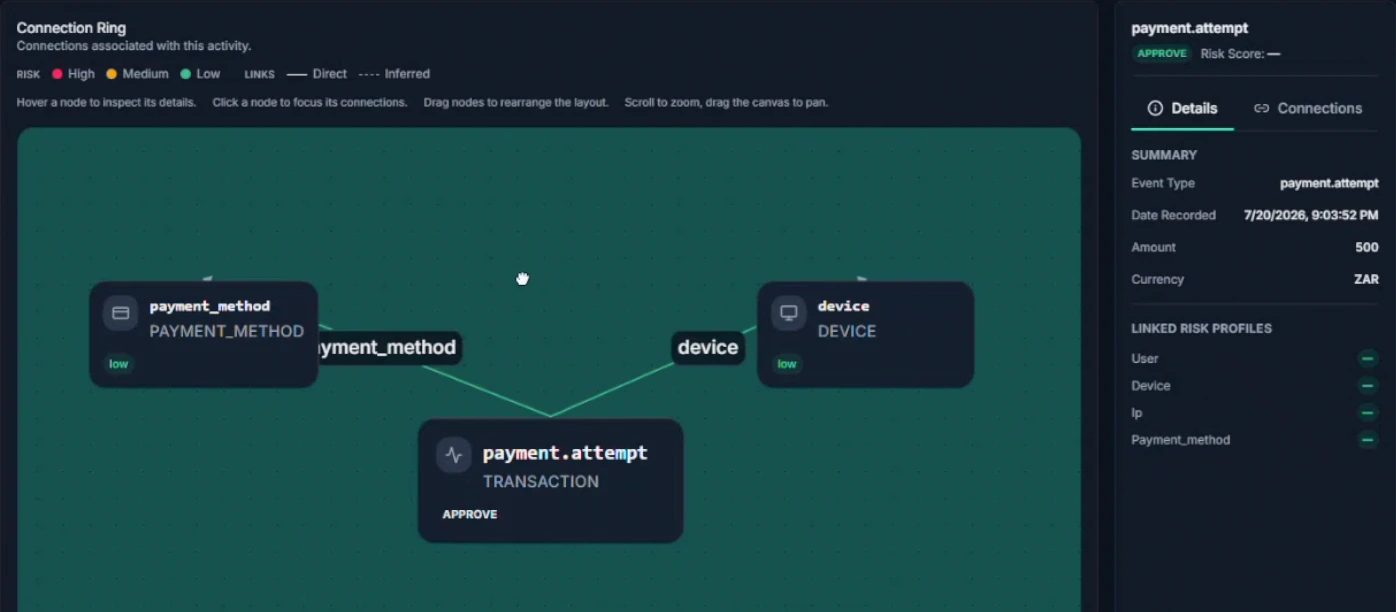
Connection Ring keeps the event, linked entities and supporting context available to the investigator. Shared infrastructure alone is not a fraud verdict.
SENTR Product viewDemo data
SENTR Connection Ring linking a payment-attempt event to a device and payment method, with a selected-node detail panel. Enlarge view
Follow the connection, not another spreadsheet

A payment event and its linked device and instrument in Connection Ring. A connection is an investigation lead, not a verdict.

Inspect the relationship and keep the underlying event in view.

Follow the connection, not another spreadsheet

A payment event and its linked device and instrument in Connection Ring. A connection is an investigation lead, not a verdict. Product demonstration · synthetic data.

One foundation. Different account-risk patterns.

iGaming multi-account abuse

Link registration, deposits, bonus claims and withdrawals before treating the claim as an isolated event.

Explore bonus-abuse controls →

Before you decide

The questions worth asking.

Does SENTR verify someone’s identity or replace KYC?

No. SENTR evaluates the events and identity-related context you supply and helps investigate linked activity. It is not a document-verification, KYC, AML or sanctions-screening service. Keep required identity and compliance services and use their available context within your agreed event workflow.

Check the scope →
Can a shared device prove that accounts are fraudulent?

No. A device, IP or payment connection can be a useful investigation lead, but legitimate people also share infrastructure. Combine it with event history, rule contributions and review context rather than treating every connection as a block decision.

Explore the entity evidence →

Bring the sequence your current tools cannot connect.

Map the events, identifiers and review decisions with us. Then agree the controls and evidence needed for a useful evaluation.

Your privacy choices

Choose how you use SENTR. Your enquiry, chat and booking do not depend on accepting analytics.

Essential functionality Always active

Delivers and secures the site, remembers this choice and supports the chat or booking you request.

Measures page visits, feature use and enquiry journeys, including recognised campaign sources. Uses analytics cookies. Form answers and chat messages are not sent to Google Analytics.

Advertising trackers are disabled. The same choices apply to UK and EU visitors.

We remember this choice on this browser for up to six months. Changing an active analytics choice reloads the page to stop tracking scripts. Save any unfinished enquiry first.

Website data information